Sunday, December 11, 2011

Dis-membering and re-membering - November 2011

Dis-membering and re-membering - November 2011
At a Playback Theatre conference in 1992, my dear friend and mentor Tarquam McKenna took a workshop concerning the dis-membering that is repaired when we re-member. I acknowledge and thank him for this insight which I continue to carry with me and to turn over and over in my mind and heart.
Recently I attended three remembrance events in England, clustered around the 11th of November.

The first re-membering, ancient worlds 11/11/11
On that day, four of us packed into a little car and made our escape from London, through the endless caterpillars of traffic.  We arrived at Stonehenge 15 minutes before it ‘opened’ though it was wide wide open to the fields and to the sky as we drove over the brow of the hill – clustered miraculously still, a conclave of wise beings beneath a grey gold sky.

After we made the procession around it, anti-clockwise as the guide encourages you to do, pausing often to notice the skylarks, rooks, movement and emptiness of that great site, we agreed that near 11 past 11, we would stop the car on our drive to Glastonbury and simply make our action of remembering wherever we found ourselves.
We slipped into one of those narrow car-stopping places where big trucks and other vehicles whipped past in the luminous morning and plunged off diagonally over a stubbly field to a copse of trees on the hilltop.  A cold wind was blowing and the earth was full of flint:  I bent over and found a flake and another of our party found a worked arrow head, maybe hundreds of thousands of years old.
We came to a grassy farm track and the four of us stopped there – we sang
“they’re rolling out the guns again hooroo hooroo
They’re rolling out the guns again – but they’ll never take our kids again
No they’ll never take our kids again, Johnny I’m swearing to you”

My son who was with us held out his big arm with a digital watch on his wrist – 11 – 11 on 11 – 11, we all saw the numbers click over.  A long long pause.  The wind whipped our hair, the world stood still.  My parents and their generation were strongly with us;  I mentioned the great uncle for whom my father was named, a boy of 17 who lost his life on the Somme – and my grandfather who was deranged by being a doctor in the 1914-18 war. We, now, are still part of those wars, formed by them but  in the silence, all of war and peace seemed to pass around, through, before, behind us. 
We sang as the moment ended  of its own accord and we walked back to the car, “all we are saying is give peace a chance, all we are saying is give peace a chance”.

A second re-membering and riotous recounting, 12/11/11.
I am named for a female friendship:  my first name belongs to another family and my second to my mother.  On the 12th of November, we had a party – the three daughters from that family along with our little party of myself, my son and the friends who had made this occasion happen by suggesting we come to Oxford at this time, who were taking care of us and having us to stay in their wonderful working flat in Jericho, by the side of the muddy river where I heard ducks quack faintly through the double glazing at all hours of the day and night.
We walked to a tall Oxford house through the chill evening and came into a brilliant and riotous world where many of us talked non-stop at the same time for three hours.  It was just as I remembered when we would drive up from Hamilton to Auckland and arrive at the big black house on the slopes of Maungakiekie – lavish and simple at the same time, beautiful and luminous, full of laughter and sometimes suddenly tears might prickle at the insides of my eyelids.  We toasted the five parents of our families, all dead now,  and the four siblings who were in other parts of this world.  The three parents of our family and the two of theirs were fast friends and we explored all kinds of speculations and wonderings about them and their secret lives over the years.  It seemed miraculous that the four of us should all be alive in this place and time, so many years afterwards.

Course succeeded sumptuous course and glass after glass of wine was savoured and all this human care and artistry added up to beauty.  Misunderstandings and unhappinesses  fell away.  We mourned the distance of the oldest of each family, the two brothers, yet  I saw vividly how happy we all would have been if either of them  had walked into the room:  as I said so, those two worldly men  seemed to me to look into the room, I saw their faces, sceptical, resistant, tolerant, appalled, amused.

A third re-membering, wisdom of 700 years 13/11/11
Suicide has lived in my family: my mother’s first husband, is said to have killed himself at the end of the war against fascism.  I can’t remember ever being told of this – his picture lived on the wall and I knew that he had killed himself because of the war.  (My mother told me that for those first months, she believed he had been killed by the British Army because he was so outspoken about the shortcomings of his commanding officers, but that is another story.)
It is a slow-motion explosion, suicide; an unanswerable remark that continues to reverberate down the generations.  All bear some of its weight, some bear more than others.
I looked a few years ago, at one of his schools, for his name on the war memorial board but found with a shock that he was not there.  Indeed, I have never seen his name on a war memorial in New Zealand.  But my friend who works at Merton College in Oxford said to me that I should think of coming there this year for the War Remembrance on the Sunday nearest the 11th November, and somehow that seemed a thing to do, since I was coming to Europe anyway in November, in this first year of my freedom from full time employment.
So I found myself, on Sunday 13th November, with my older son and this clever intuitive friend, waiting in the archway between two quadrangles, where I saw that his name appears with those who died in the 39 – 45 war.  How much this says about Merton as a seven hundred year old community of thinkers!
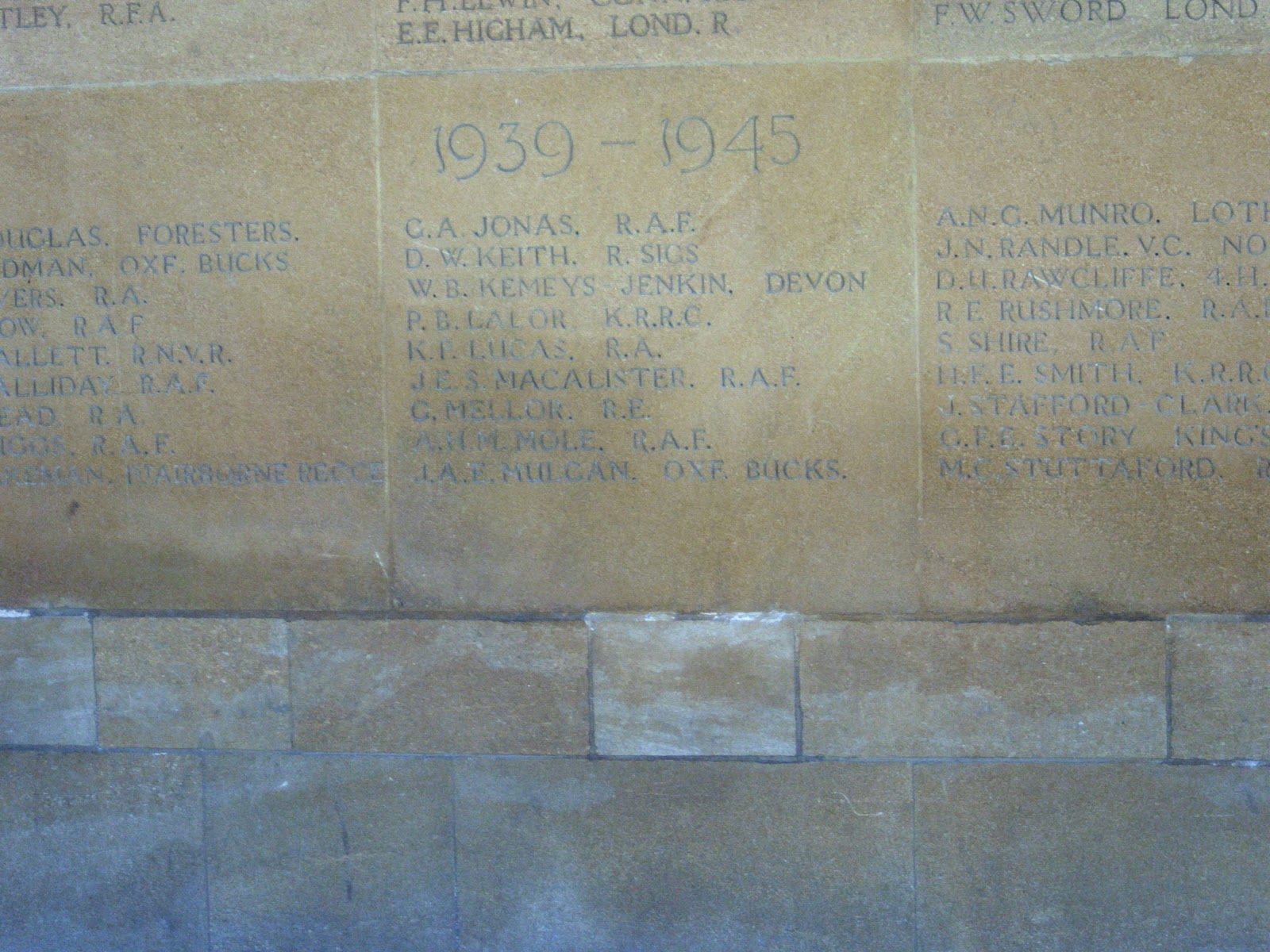
We got there early and stood around in the sun streaming through the archway,  as people arrived in dribs and drabs:  the chaplain in black dress, a young man with a trumpet and music stand, the distinguished warden and his equally distinguished wife who had been deputy principal of a difficult urban school.  Finally the simple service started and the boy played the trumpet, bringing other students out from their rooms to watch from near or far.
 I remembered how as children we used to look for the Last Post player in the bush up behind the cenotaph in Hamilton and try to put him off – there was an urban myth that if you showed a lemon, he would be unable to play. This would have been when I was about six, in 1955.  With a shock I realise that was only ten years after the war.  We never thought really what it was about except when I would wake up in my narrow room that had been a sunporch, in a grey autumn dawn and hear the awful crunch crunch of the march at the Dawn Parade and feel a hand of pure horror reach out for me.  I would turn over and burrow into my warm bed and try to forget whatever it was.
Now though, I let myself be with what was happening and feel what was being said;  no longer resisting it or seeing it as glorifying war but simply grieving for the young people who went and never came back.   A rock of pain was lodged in my throat and on my chest.  I felt I might cry and never stop crying as we stood together for a long moment of silence.   At the end a different trumpet call was played, one waking us up again to a world we share.
We can’t bring them back – what has happened has happened.  But some of the dis-membering we may be able to repair and it seems to me we do it when communities assemble to bear pain together.   We put back the pieces of ourselves and lean on one another.  Time is so short yet healing is long and patient and will wait for us.

Kaatutya - totems by Flinders St station

KAATUTYA Eloquent communicators, silent, contained, potent : totems by Flinders St
In July this year, in Melbourne, near Flinders St station and the river, I found these beautiful totems standing surrounded by cars, trams, trains and passers by. They stopped me in my tracks, they spoke to me quietly. I had to stop walking to feel them, standing as they did by river and grass among gum saplings that spoke to them, with whom they seemed to live interdependently. As we do too, with all trees, those blessed providers of the air we breathe.
I had to walk amongst this speaking forest and as I walked up and down, I came upon an inscription which put into words some of the things they were speaking of. I never found an artist’s name but I honour that person from the bottom of my heart, for making such a powerful piece of public art. Also, I think of Pete, to whom the piece is dedicated. There are many other stories on the poles: thank you, thank you. Your reminders feed me still.
‘KAATUTYA
We have a unique opportunity to make assessments on many levels
As artists, as members of a community and
As individuals. We review our environment both
The physical and the emotional, In retrospect and
into the future, translating the positive and negative
in the context of the Journey.
With one change brings a thousand changes and with
Those thousand chages one hundred thousand more
And so one story becomes a library of narrative
The removal of one tree will forever change that
Landscape, the removal of a people will forever change
The story, the only thing that is certain to remain are
The scars...
Shaping lives and forever reminding those who
Choose to see, of another history.
...and as we search for a key, the legend of
This map, we are reminded of the words
Our brother used to say
“listen to the Ground.”
For Pete
17.1.68 - 7.1.99’
If you’re in Melbourne look for them down by the river, between Flinders St Station and the Melbourne Aquarium.
(So strange that it has taken being here in Singapore, rain falling, soft warm air, trees and leaves among the buidlings, for me to be able to write about these powerful poles. It’s having time and space, I guess, but also looking for traces of those who have been here for thousands of years on THIS island...and then it’s in Newark, winter sunrise early morning when I actually get to post this...)

Friday, October 28, 2011

A world in a railway carriage: MY rugby world cup


That game was a constant presence in my childhood.  We used to be taken along the road in Otahuhu to watch Dad’s rugby practice: it was almost unbearably romantic to be out after tea in the cold dark air, our breaths turning to smoke.  We would run up and down the huge grassy stepped slopes gazing down at the lit paddock where grown men threw themselves in the air crying out unintelligibly – “ho...o...eeeaah”.  It was complete and beautiful.
Later, Dad got us to run up and down the lawn, passing the ball across in front of us.  I knew he wanted us to love it as much as he did and I wanted to too - but it didn’t work with us three girls and he gave it up in the end.
Still later, one of the boys on the rugby team he coached at Boys High died after a game;  I think from a broken neck.  Dad came home and wouldn’t talk, he went into his study and shut both the doors leading in that direction.  The terrible wordless feeling of grief and horror got attached to the game in my mind and when I had sons without even thinking about it I actively kept them away from that game.
Even so, I got reconciled to it when I saw what pleasure it gave my parents as old people.  No matter how vague my Dad was about daily life, if a rugby game came on TV, he would scrunch  up on the edge of his chair and exclaim ‘get it out wide, get it OUT!’, living the drama of every move and turn of the play.  Mum too would know all the players names and enter into their predicaments on and off field with passion.
So when it came to the World Cup, there were lots of strands... I participated to the extent that I did partly for Mum and Dad who didn’t make it.  I could imagine their comments, their enthusiasms and Mum’s lively curiosity about Auckland’s transformation.  On the opening afternoon, I went down to town partly to be able to report on what was happening, even in my mind, to my disappeared parents!  How strange... and what was happening was even stranger as the streets filled up, the toilets at the station stopped working and it became impossible to move.
I had arranged to do a meditation that afternoon out at Ranui, something which really pleased me, it seemed oddly perverse to be going completely in another direction.  Yet the train track would take me past Eden Park and so I’d be able to catch a whiff of the flavours even in passing; so it turned out as I took my seat with great relief and escaped that overcrowded waterfront.  There were many people bound for the Opening Ceremony, some carrying silver pieces of card with them and conversing excitedly at the tops of their voices.  All ages, all sizes, all ancestries crammed on to a little carriage, where flags and colours communicated jubilantly to one another.
After a luminous and tender meditation, I heard that the trains were disrupted.  I walked to Ranui Station in the dark, adventurous, and a bit nervous about whether I would get home.  At the station, a security guard stood amid twenty or so young people.  The young ones were so excited!  I felt so sad that we don’t have more occasions like this where they can go downtown to free entertainment and feel the whole society affirming their playfulness.  (When I said this later to a friend she said sourly ‘You know they just went and got completely pissed, it was chaos in town!’  I don’t want to be unrealistically starry eyed – but I still think that it would be great to have more public festivity that teenagers can have fun at!).  I talked with the security guard from India about this, the lack of fun provided for young people by NZ culture in general.
A sturdy young Māori man caught sight of me sitting there and did a double take – at a white haired Pākehā woman out by herself I guess on that most sociable of nights.  “Oh – kia ora whaea!”  I answered with kia ora and then a friend of his carrying a tino rangatiratanga flag muttered “Kei te pehea koe?”
“Kei te pai ahau – me koutou? (I’m good and all of you?)  He did another double take and started laughing.  I commented on his flag and how I liked it (also in te Reo Rangatira).  They stayed near me on the platform, didn’t talk any more to me but now I felt warm, not cold.
A group of young Pākehā girls tiptoed onto the platform in their incredibly high heels.  They were gorgeous, sleek, slim with long clumsy legs and heavy feet.  They looked at me but didn’t speak and moved on down to the end of the platform furthest from the young men.  So we waited.  And waited.  Finally a train came past in the outward direction – sigh of relief, this meant that we were going to at least start into town, when it turned round and came back in ten minutes.   Sure enough, ringing of crossing bells, bright headlight in distance, we all jumped up and ranged ourselves along the edge of the platform.
At long last, here we are in a carriage.  I sit near the middle of the carriage, the boys behind me in a big group eight or nine of them now.  At the other end of the carriage the six girls sit close to one another.  And so we start off.  At the next station, three Pasifika girls get on and sit on the lengthways seats just across from me.  At least, I think they are girls, also done up in high heels and short skirts, but when I look more closely, I realise they are fa’afafine, boys acting as female this (perhaps every) evening.  Their strong wrists and jaws give them away as they sit in a row, looking at their reflections in the dark glass opposite.  One of them smoothes and re-arranges her fringe, unceasingly, obsessively.  I also gaze,  fascinated, mesmerized, looking away whenever one of them catches my eye.  I don’t want to be intrusive but I delight in this repeated gesture with all its self love, defiance and insecurity.  I think how symmetrical this carriage is, with the female and male ends of the carriage and us queers in the middle!
Every now and then the most exuberant boy, the one who first spoke to me, starts to  half sing half yell “Ooh ooh shake your booty!” over and over again and some of the others join in the chant half heartedly.  As this grows at one point, the tallest, slimmest, smartest girl gets up and starts doing a spiralling bending dance with the railway carriage pole.  All of us, the whole carriage erupt into laughter.  I am deeply gloriously happy, we all are!  As we rock on through the dark, I think, yes, this is MY rugby world cup moment.  Thank you Aotearoa...

Tuesday, September 28, 2010

Images of my grandmothers and their sisters


This is Bimmy (on the right) at the Misses Rice Dancing School in Munich in the early 1900s.

Bimmy (second from left) and Willie (left) in Munich

Dancing School medal to mark the closing of the Misses Rice Dancing School in Munich in 1909
We were all given one of these medals by Bimmy when we were very little.  


This is Bimmy as a married woman in London, with her two older daughters, Sylvia (on right) and Joan (the baby). Her cousin's daughter Enid is on the left.  Note how they are sitting in the garden - Bimmy always used to say to us "A garden is not complete without a sitz-platz.

Sylvia was a wonderful friend, supporter and engaged influence in the lives of her young relations.

The New Zealand side - the Woodford sisters

Mop (top) and her sisters in the orchard at Opotiki


Mop and her sisters later, at Bunty's wedding

This picture shows Teddy on the left, then Rosie, Maunie, Eva and Mop on the right.

I celebrate all of these determined women who went before us.

Saturday, September 25, 2010

A visit from my grandmothers and their sisters

A visit from my grandmothers and their sisters


It was January 2009: I had just attended my Ph D graduation. It was the first graduation I had ever attended. I was 59 years old and had been working on my Ph D for seven years, looking at Playback Theatre as professional development in three primary healthcare centres. I called my Ph D Tracing out Patterns in a world in Slippage – the more I looked at memory, storytelling, performance, the more I was in contact with the reality that human interpretations are like flute music floating out across a lake at night time – fragile and fleeting in an infinite world.

I would probably not have attended the graduation but my mother had raised it with me, indirectly, as she so often communicated (as do I). She had asked me about going to graduation and I had said no, our generation, the 60s mob, never did, we were always capped in absentia. A week or so later she said to my older son, as we visited her in the room in the old people’s home she had inhabited since my father died, surrounded by paintings of the four of us, her children: “And she says she’s not going to go to graduation, how ridiculous, I never heard anything so ridiculous!” I protested, “Mum, I didn’t know you thought that, we never have gone to graduation, that’s not what our lot ever did!” and she responded scornfully, “It’s not about you, it’s about your institution, they supported you all these years, you owe it to them!” She died less than two weeks later, at the age of 91, two days before what would have been the 60th anniversary of her wedding to my Dad who had died three months before.

So, anyway, I went to graduation! I wasn’t about to go against her advice, given so powerfully at such a point in our life together... and I was glad I did too, with an ex-bishop from the Anglican church capping me (something she would have loved I knew); the small taaniko kete from Grandma Maria from Waikaremoana tucked under my arm; colleagues on the stage standing to honour me; and Aunty Wai’s karanga to me (to the kete I thought) ringing out across the Aotea Centre. Afterwards, we had dinner in the pub in Aotea Square and I got home to an empty house quite early, maybe 9.30pm. It was a beautiful balmy Auckland night and I wanted to sit outside on the verandah, in the dark, with streetlights making shadows of the queen of the night, bamboo and lasiandra bushes growing up through the balustrade.

I sat there, so full, so complete somehow. And then amazingly, my grandmothers and their sisters, the first people to whom I had dedicated my thesis, came up the steps to where I was sitting, very simply and naturally, they came one by one into my mind and heart.

First, Ethel, know by me as Bimmy, my caregiver when I was a baby... she who had gone to Munich at the age of 21, with her sister Margaret, so that Margaret could study painting there. Magic little woman who lived by stories and songs and who told me when I was a child, “if anyone says you should not believe in fairies, just tell them, William Shakespeare did!” Half Irish, full of second sight, healer, dancer, brave heart who came to New Zealand at 72 saying to my aunt Sylvia, “Well, my grandchildren are in New Zealand, so you’d better take me there.” She lived until I was 21, and I now know that she saved me from the squashed place 13 months behind my beautiful older sister by taking care of me, telling me stories, communicating with me that imagination can be something to live by.

Then came her sister Margaret, who had initiated that magical journey to Munich which has led to our whole family of cousins in Germany, who live in ways we all recognise, precious kin over all these miles and years: Thomas, Veronika, Martin, Nikki and the wonderful young ones too, Til, Nele Sampo and Neomi all of whom I have met and recognized. Margaret whose life was so full of art, suffering, gardens – whose sweetness and kindness was remembered with such clarity by my mother – who was a founding member of the Munich Women Artists’ Association, with whom Bimmy started the “Misses Rice Dancing Academy” because they didn’t like teaching English and “the German girls were great lumps who needed exercise” that is how Bimmy used to say it to us. What training had they ever had in dancing? How astonishing it was, that they should go from being daughters of the Rectory in Cheam Village to living in Munich, starting their own business, then Margaret having two babies before being married, to her ‘little philosopher, Dely” Rudolf von Delius. She did in the end marry Dely, and had the third child Erika, whom I met in the mid 1990s and who said to me “This is not like strangers meeting, this is like finding one another again!”

Others of my grandmother’s sisters came up the steps too – first Aunty Polly whose furniture we grew up with: the oldest daughter, she had kept house for her father because her mother ended up an invalid, living upstairs with a nurse, having had puerperal insanity (post-natal psychosis which I had mildly after my second child when I was convinced that the doctors in National Women’s kept bringing medical students to see me because I was dying and that they hadn’t wanted to tell me because it might depress me! I would think, this is depression, but then would say to myself, well of course, I am depressed because I am dying!). So that Great Grandmother came too, up those night time steps, Eleanor Macan of Meryon Square Dublin, whose father had started off a pupil teacher in Sligo and ended up as a Judge in Dublin. Eleanor who played the piano so brilliantly, and whose small lapis lazuli box for calling cards has been with me for many many years, I can’t remember when I was given it. Aunty Polly did not have children; she did not marry Uncle Reg till she was older, in her 50s. She lived in a women’s club sometimes in London and mum and her sister Sylvia sometimes stayed with her: Aunty Polly said, “I like to be alone in a crowd.” What did she do for a living? I wish I knew. I know she was in Canada at some point – did she do things like be housekeeper in schools or institutions?

Another of Bimmy’s sisters, came up the steps, such a beautiful girl, Nellie who had had a baby, Bernard and then died so young –Bernard had then been brought up in the household at Cheam, like a younger brother. The last time I saw Bimmy she said (92 by then, in a home in Remuera) “Isn’t that Bernard, playing outside on the lawn?” And finally, Aunty Alice, who Mum always used to say must have been perhaps schizophrenic, who lived down by the Thames estuary, and sent us copies of Alice in Wonderland and Alice Through the Looking Glass, when we were little kids. Aunty Alice, who looked after people’s children and always sent a handkerchief to each niece or nephew for their birthday each year, who was so kind and so unfitted for the world as it turned out to be...

None of these women went to university – none of them had any hope of that. Nor did my mother who should have gone to the Royal Schools of Music - or my aunt Sylvia, who had wanted to study geography and chemistry. Their father died when my mother was 13 and Sylvia was about to leave school. Sylvia was called to the headmistress’s office and taken to my grandfather’s office in the London County Council where she had to identify him. He was just lying on the floor, dead, with not even a blanket over him. It turned out that there was no money, so Syl had to get jobs straight away and so did Mum when she left school. Bimmy got a house in Oxford, against her brothers’ wishes, (“You can’t possibly get a mortgage!” She was in her mid fifties and she DID get a mortgage!) and had paying guests, graduate students and summer school students in the long vacation.

I was aware of Joan too, the middle one of three, as I am. She is the baby in the photograph to the right here. She was funny and brilliant, a cellist, who died in late teenage, after whose death Bimmy went into severe depression. She has travelled with us all through our lives, like beautiful Nellie.

It was as if they acknowledged what I had done, all the women on that side – and then the New Zealand side came too – my grandmother Olive, known to us as Mop, and her sisters Teddy, Rosie, Maunie, Ella, Eva... none of them had gone to university though several of them had been teachers, one down the East Coast in Omarumutu, and Mop in Waitotara, where she had ridden a horse every day over the hill to school. Even my aunts on my father’s side had not gone to university – one nurse, one phys ed teacher – until Bunty went and did a BA in her forties.

I sat on, in the warm January night, and it was as if each woman came in turn – all dead now – even my darling aunts Bunty and Mary who were so much younger than Dad but died before him. Each one came singly up the steps and I registered the flavour of each – Mop so pleased, Teddy somehow brisk, Mauny dreamy and poetic, Ella so beautiful and absent minded, Rosie cryptic and mysterious, Eva so small and round and kind, whose cottage on the beach at Ohope we have all inherited jointly and try to share intelligently...Bunty so clumsy and loving, Mary so snobby but so practical, so breezy, so full of care...

Finally it was as if they had all come and greeted me and I was free to go inside and take off my gown and shower and sleep. What did they come to say? I found it impossible to summarise – but through this visitation I realised in my skin and bones how new it is that a woman alone, like me, would have the chance to study deeply and do the kind of brooding enquiry I had been able to do. I know not to take this for granted – and I know that however privileged I might have appeared – daughter and sister of professors, that long drought that banishment of women from the academy had only broken in my generation. I thought of my sisters and female cousins who have gone to university in NZ, Britain, Canada, Australia and Germany - and my nieces, one already with a Ph D before she’s 40, one with a science degree now studying medicine in Australia, one just starting on an art and design degree. I sent my love and thanks back through the years to those women who had visited me – for their creativity, their determination, their wildness, their courage, their perseverance, their love. As I said in the dedication in my thesis – “because you were, we are.”


Fe Day, Auckland, 2010 Fe.Day@aut.ac.nz